







WIEN2k-Computer requirements
Computer requirements
- The program is written in FORTRAN90 and runs under Linux/Unix on practically all platforms (single Linux-PCs to high-performance clusters, IBM RS6000, SGI ).
- The most efficient platform changes rapidly with time, although we expect that the best price/performance ratio will also in future be some Linux PC based on an Intel architecture with high memory bandwidth (Intel I7 architecture or Inter Xeons (more expensive); for current benchmark tests click here ). Install the Intel ifort compiler + Intels mkl-libarary (www.intel.com) or use gfortran + openblas.
- It requires at least 1 GB memory for small systems (to about 10 atoms per unit cell) or more for larger systems. At present we recommend a multicore CPU with 2-4 GB memory / core and twice as much swap space (don't forget to configure the latter!). We have treated systems up to 100 atoms per unit cell on workstations with large memory (16 GB) and with more than 1000 atoms/cell on clusters with 64 - 1024 cores and fast network. 1 GB (or 10-1000GB for large cases) of disk space is required.
- k-point parallelization is possible and highly efficient on a cluster of PCs (Gbit network is enough), provided a common NFS-file system is available and login (rsh or ssh) is configured properly.
- A fine grain parallelization for a single k-point is also available. It requires fast communication (shared memory or fast networks (Infiniband), Gb Ethernet is not really sufficient), MPI, FFTW, ELPA (optionally, but highly recommended) and Scalapack.
- In order to use all options (including the graphical user interface or XCRYSDEN) the following public domain packages must be installed on your system: xcrysden, tcsh, ghostview (+png support), gnuplot (+png support), pdf-reader, graphical www-browser (firefox), Perl, python (2.7 or higher), octave.
- Additional useful (optional) packages include: VESTA, Wannier90, libxc, phonopy.
Graphical User Interface and User's Guide
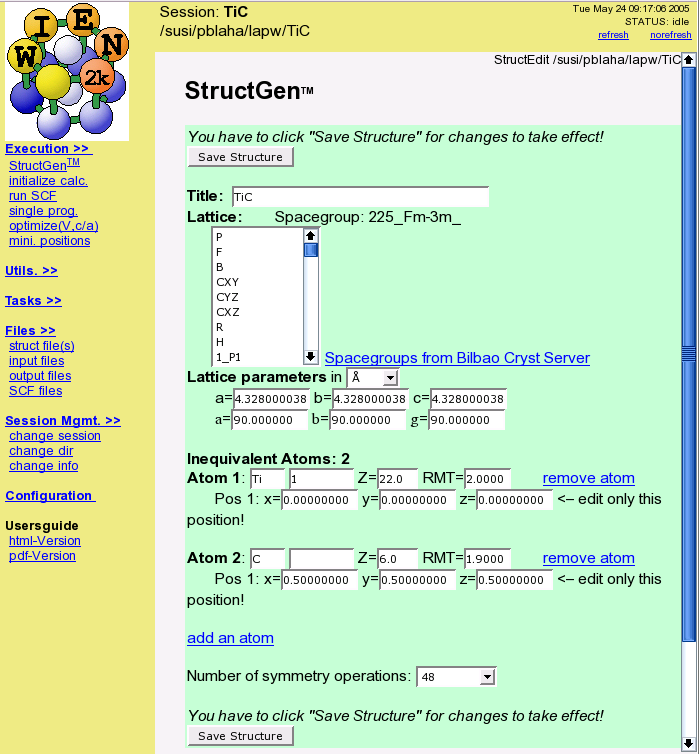
A user-friendly environment W2web ("WIEN to WEB") makes it easy to generate or adapt inputs for many applications. It also guides the user to perform various tasks (e.g. electron densities, DOS, etc.).
A User's Guide (155 pages) (ps, pdf and html versions) explains all essential steps, input and output files, etc.
See a screen-shot of the Graphical User Interface (52kB)
Interface to external visualization programs
- The current version of the "WIEN to WEB" interfaces directly with the visuatization and rendering tool XCrysDen. You can render the structure, plot 2D and 3D electron densities, generate k-meshes and visualize Fermi-surfaces.
- Another very good rendering program interfaces with WIEN2k is VESTA.
- cif-Format: Interface programs to read and write cif files is available.
- XYZ-Format: Interface program to read xyz-files is available.
©2001 by P. Blaha and K. Schwarz